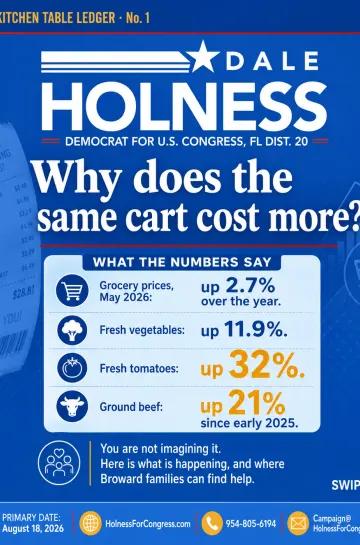
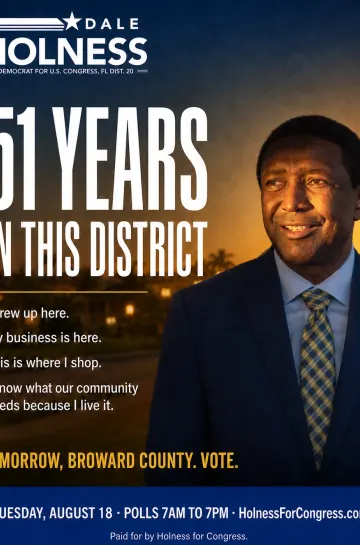
In down-ballot races, many voters know little about the candidates, and in nonpartisan contests they get no party label to lean on. Research finds a familiar name can raise support in these low-information races, in part because voters read familiarity as viability. The best-qualified candidate still has to reach voters across the district before ballots arrive.
Key takeaways
- Down-ballot races are the contests below the top of the ticket: judge, school board, city commission and more. Voters often know the least about them.
- When voters know little, a familiar name can win support because it looks like a serious contender. In the research, that effect faded when voters had a more relevant cue: incumbency.
- In Florida, judicial and school board races are nonpartisan. Ads cannot state a party, and a majority in the primary can settle the race.
- Reaching a whole district takes repetition over months, not one short burst. A digital program starts early and keeps the same name, photo and background in front of the same voters.
- Start before mail ballots go out, lead with your background, and use one name and one look everywhere.
What is a down-ballot race?
A down-ballot race is any contest listed below the headline races on your ballot. Dictionary.com defines down-ballot as relating to a candidate or contest that is relatively low-profile and local compared with the races listed higher up. A down-ballot candidate might be running for circuit or county judge, school board, city commission or county office.
Low-profile does not mean low-stakes. Judges decide cases in your courthouse. School board members govern your local schools. City commissioners vote on budgets and local rules. That is why down-ballot voting is important: these offices sit closest to daily life.
In Florida, two familiar kinds of down-ballot race are nonpartisan by law:
- Judicial races. Section 105.011 states that a judicial office is a nonpartisan office, and it bars candidates from campaigning or qualifying for it based on party affiliation.
- School board races. Section 1001.361 says school board members are elected in a nonpartisan election as provided in chapter 105.
On the ballot itself, section 105.041 says no reference to party affiliation shall appear for any nonpartisan office or candidate. A voter looking at a Florida judicial or school board contest sees the office and the names. For a city race, check your city’s rules with your city clerk or Supervisor of Elections.
Why do voters skip or guess in down-ballot races?
Because many do not feel they know enough to choose. One useful set of data comes from judicial races in Ohio.
An October 2014 survey of registered Ohio voters by the Bliss Institute at the University of Akron found that the biggest reason Ohioans give for not voting for judges is that they don’t know enough about the candidates. About half of the survey respondents reported drop-off in judicial elections. The same Court News Ohio report notes that Chief Justice Maureen O’Connor had expressed concern that in some elections more than a quarter of the electorate skips voting for judges listed near the bottom of the ballot.
The Ohio report calls this drop-off. Researchers also call it ballot roll-off: a voter casts a ballot but skips contests further down it. A study of more than 1,100 trial court elections in 19 jurisdictions found that contested partisan elections produce the lowest roll-off, all things being equal. If the Ohio pattern holds in your race, many of the voters who leave it blank simply never learned enough to choose.
The Ohio survey also shows what voters want to know. Respondents said the professional background of judges is the most important thing to know, far above political party affiliation. That is one Ohio survey, not Florida data, but it points to what voters look for when the party label is gone.
Voters who do not skip still have to decide, and with little to go on, many reach for shortcuts.
Why does the best candidate not always win?
Because being the best candidate is not the same as being the known one. In low-information races, familiarity alone can raise a candidate’s support.
A familiar name looks like a serious contender
Political scientists Cindy Kam and Elizabeth Zechmeister tested this with three laboratory experiments and a field study. Their summary of the work reports that in low-information races, where people have very little to go on, name recognition positively affects political support. A key mechanism is viability: people see a more familiar candidate as more viable and rally around that candidate. The effect holds only in low-information races, but those races make up the majority of decisions voters make on a ballot.
Familiarity is not automatic. It is built, exposure by exposure, and building it is the campaign’s job.
Incumbency changes the math
The same study has a limit that challengers need to hear. According to the journal abstract, the name recognition effect dissipates in the face of a more germane cue: incumbency. When voters know which candidate already holds the seat, the boost from a merely familiar name fades.
For a challenger, familiarity is not enough. Voters need your name and a reason to make a change.
First impressions form fast
A 2005 study in Science found that judgments of competence based only on candidates’ faces, formed within a one-second exposure, predicted the outcomes of U.S. congressional elections better than chance, including 68.8 percent of the 2004 Senate races. The authors suggest that rapid, unreflective impressions can contribute to voting choices.
People form impressions from very little, so use one clear, current, professional photo everywhere and make that impression an accurate one.
What changes in a nonpartisan Florida race?
The party label disappears, the primary can settle the race, the calendar runs short, and judicial candidates face extra limits.
No party label in your ads
Florida Statutes 106.143(3) says a political advertisement of a candidate running for nonpartisan office may not state the candidate’s political party affiliation. The section does not prohibit an ad from stating a candidate’s partisan-related experience, but a nonpartisan candidate may not campaign based on party affiliation. For judges, section 105.071 adds that a candidate for judicial office shall not campaign as a member of any political party or publicly represent or advertise as one.
Without a party label, your name, background and look do the work a label would have done. Your ads still need the “paid for and approved by” or “paid by” disclaimer that section 106.143(1) requires for candidate-paid political advertisements. On Meta, advertisers who run ads about elections, politics or social issues must complete an authorization process and include a “paid for by” disclaimer. Our guide to Facebook and Instagram ads for political campaigns walks through the setup.
The primary can settle the race
Under section 105.051, if a candidate for circuit judge, county court judge or school board wins a majority of the votes cast in the primary, that candidate’s name does not appear on any later ballot unless a write-in candidate has qualified. If no one wins a majority, the two candidates with the most votes go on to the general election.
With only two candidates in the race, one of them will almost always clear a majority, so the primary is effectively the election. Build your plan around the primary date, not November.
The calendar is shorter than it looks
Here is the Florida math, straight from statute:
| Milestone | When | Source |
|---|---|---|
| Judicial qualifying | Noon of the 120th day to noon of the 116th day before the primary | Section 105.031 |
| School board qualifying | Noon of the 71st day to noon of the 67th day before the primary | Section 105.031 |
| Requested mail ballots sent to military and overseas voters | No later than 45 days before the election | Section 101.62 |
| Requested mail ballots sent to all other voters who asked for one | Between the 40th and 33rd days before the election | Section 101.62 |
For a school board race, qualifying closes on the 67th day before the primary, just 27 days before the 40-to-33-day mailing window opens. Wait until qualifying to introduce yourself, and many voters may hold a ballot before they ever see your name. Meta adds its own deadline. In its plan for the 2026 midterms, Meta says it will block new political, electoral and social issue ads during the final week of the U.S. election campaign. Ads that recorded at least one impression before that period can keep running. The post does not say whether the block also applies before primaries. Our Florida campaign advertising timeline counts back from these dates.
Judicial candidates: background carries the message
Florida judicial candidates also follow Canon 7 of the Code of Judicial Conduct. As set out in An Aid to Understanding Canon 7, a judicial candidate shall not make pledges, promises or commitments on cases, controversies or issues likely to come before the court that are inconsistent with the impartial performance of the office. A candidate also shall not knowingly misrepresent the identity, qualifications, present position or other facts about the candidate or an opponent. The aid says it was last updated in October 2021.
That leaves a judicial campaign with a narrow but strong message: who you are, what you have done, and how you will conduct yourself. Our guide on how to write a campaign message voters remember shows how to shape it.
This is marketing guidance, not legal advice. Judicial candidates should confirm current rules with the Florida Judicial Ethics Advisory Committee or their own counsel, and every candidate should confirm qualifying and disclaimer rules with the Florida Division of Elections or their Supervisor of Elections.
How do you reach voters spread across a whole district?
With digital ads that reach across your whole district and keep running for the length of the race. Here is the size of the job.
Even one city commission district is a lot of voters. In Tamarac’s District 1, 8,734 votes were cast in the 2020 commission race and 8,074 in 2024, according to Broward County Supervisor of Elections results, the same records behind our Marlon Bolton case study. Many school board races are districtwide: under section 1001.361, Florida school board members are elected by the qualified voters of the entire school district, though some districts, including Broward and Miami-Dade, elect some or all members from single-member areas instead. That is a lot of people to reach, and no candidate starts out known to all of them.
Digital ads carry your name across the district
Recognition is built by showing up consistently in front of the right voters, in the right district. Digital ads put your name, face and background in front of the same voters again and again, on the platforms those voters already use every day.
In two randomized tests of week-long Facebook ad campaigns, where voters typically saw many dozen ads, exposure did not increase name recognition or favorability. We build a longer plan: one name, one photo and one message in front of the same voters, starting months before ballots go out and running through Election Day.
Targeting is the other half of the job. Ads can be aimed at the area your district covers rather than a whole county, built from the cities and ZIP codes inside it, and they can run in more than one language, so Spanish-speaking and Haitian Creole-speaking voters see the same background your English ads carry. A candidate’s paid ad still needs the disclaimer section 106.143(1) requires, and Meta ads need the advertiser authorization Meta requires for election ads. The reporting shows week by week where the money went and how many people it reached. Our guide to name recognition in politics lays out a full plan.
What should a down-ballot candidate do first?
Start with the basics that make every other dollar count.
1. Make yourself findable
Voters who see your name may look you up. Give them a campaign website that loads fast on a phone and answers three questions on the first screen: who you are, what you have done and what office you want. Keep it current with events and ballot dates.
2. Use one name and one look everywhere
Use the name voters will see on the ballot, and the same photo, the same colors and the same typeface across your ads, your video, your social profiles and your website. Voters do not sort your exposures by channel, so every exposure should point to the same name.
3. Lead with your background
When there is no party label, background is the message. For a judicial race, that means your experience and your conduct, within Canon 7. For school board or city commission, it means what you have done in the community and why it qualifies you for the seat.
4. Start before mail ballots go out
Count back from the 40th day before the election, when the window for mailing requested ballots opens. Ballots for military and overseas voters go out even earlier, no later than 45 days out. Finish Meta’s ad authorization early, have your creative ready, and be visible well before that window opens.
5. Speak your voters’ languages
If voters in your district speak Spanish, Haitian Creole or another language at home, put your background in front of them in that language too. A translated site page and an ad in each language can reach voters an English-only campaign misses.
What does this look like in real Florida races?
Two of our clients ran exactly the kinds of races this article describes.
Marlon Bolton, Tamarac City Commission, District 1. Advocacy Aces worked all three of his campaigns, in 2016, 2020 and 2024. The results on our case study come from the Broward County Supervisor of Elections: in 2016 he defeated the incumbent, and in 2020 and 2024 he won again as the incumbent, carrying every precinct in both races. See three Tamarac City Commission elections with certified results.
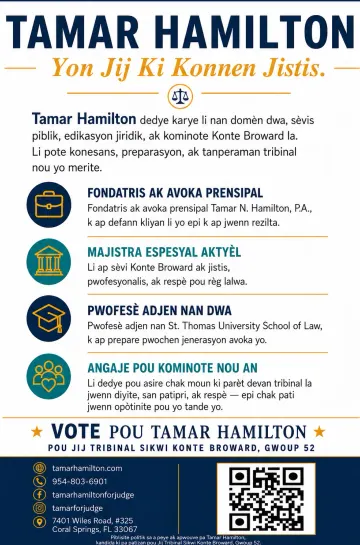
Tamar Hamilton, Broward County Circuit Court Judge, Group 52. She won the most votes in her three-way August 2026 primary and advanced to the November runoff. We delivered the website rebuild at tamarhamilton.com, Meta ads, print-ready pieces and custom Zoom backgrounds, with creative in English, Spanish, Haitian Creole and Portuguese, all for a race governed by Canon 7. The result belongs to her campaign. Our case study shows the work behind a Broward County judicial campaign in four languages.
How Advocacy Aces helps down-ballot candidates
Advocacy Aces is a digital advertising and creative agency for law firms and political campaigns, working in English, Spanish and Haitian Creole. For judicial, school board and city candidates, one team handles the pieces this article covers:
- Digital ads that reach voters across the district on Facebook, Instagram, Google Search, YouTube and X, with targeting, copy, creative, media buying and reporting in one place.
- Campaign websites built fast on Vercel, so updates take hours, not weeks.
- Campaign graphics with one consistent look for ads, social posts and your website, so every exposure carries the same name, photo and colors.
- Copywriting for ads, your website and everything else voters read in your name, written in your voice.
You keep ownership of your ad accounts, ad spend is paid directly to the platforms, and we walk you through the reporting. We take one client per race, so we never work for your opponent.
If you are running for judge, school board or city commission and want your name in front of voters before ballots arrive, Schedule Consultation.
This article is marketing guidance, not legal advice. Election, platform and bar rules change, so confirm the details with your campaign counsel, filing officer or bar before you rely on them.