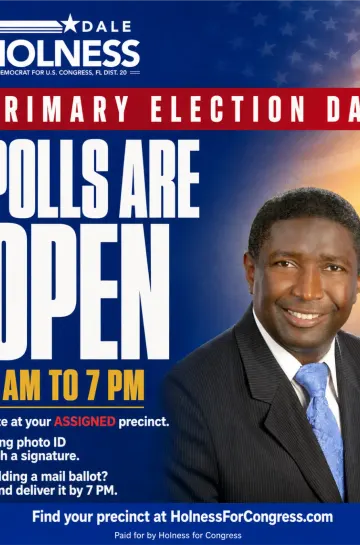
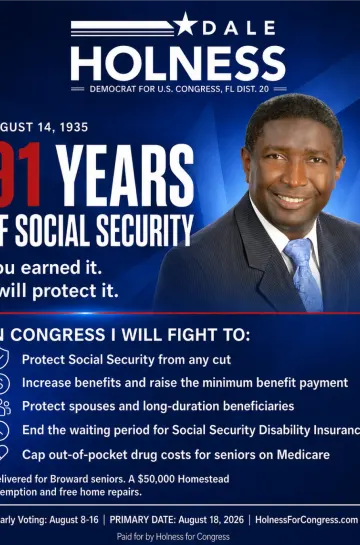
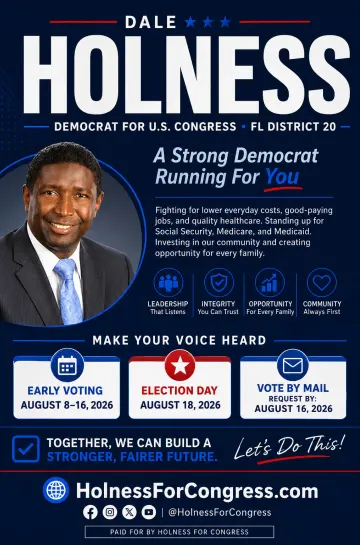
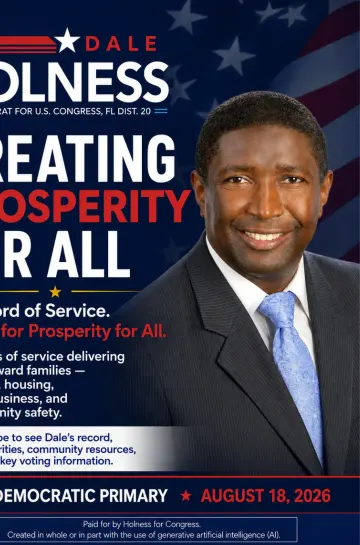
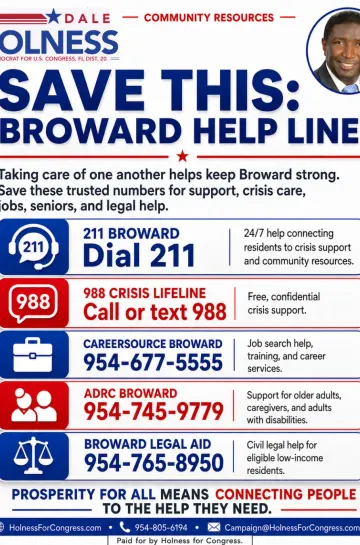
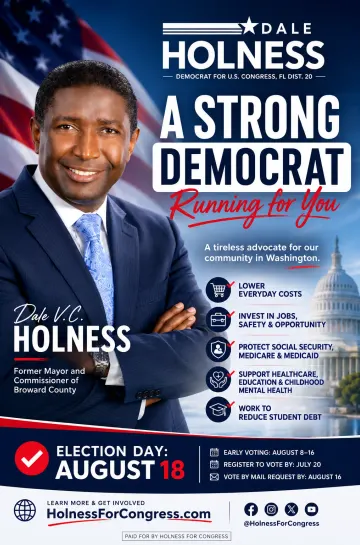
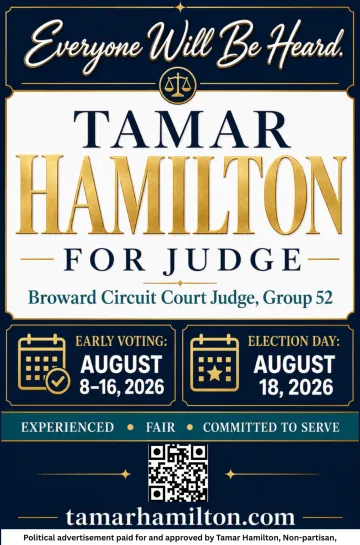
A Florida political advertisement paid for by a candidate must prominently state either “Political advertisement paid for and approved by (name of candidate), (party affiliation), for (office sought)” or “Paid by (name of candidate), (party affiliation), for (office sought).” Ads paid for by anyone else, independent expenditures, electioneering communications, texts and some AI content follow different wording in sections 106.143, 106.071, 106.1439, 106.147 and 106.145.
Last reviewed October 23, 2026, against the 2026 Florida Statutes and the Division of Elections handbook revised September 30, 2026. This is marketing guidance, not legal advice. Confirm your wording with your campaign counsel and the Division of Elections before an ad runs.
Key takeaways
- Wording depends on who pays. A candidate’s own ad, a party or committee ad, an independent expenditure and an electioneering communication each have a different required statement.
- Use the statute’s words exactly. The Division of Elections handbook says the alternatives in section 106.143 must be verbatim and that variations are prohibited by law.
- Party rules depend on the office. Partisan candidates state a party. Nonpartisan candidates may not.
- Non-incumbents never say “re-elect.” They put the word “for” between their name and the office.
- Texts, calls and AI-generated content have their own rules in sections 106.147 and 106.145.
- Meta’s and Google’s “Paid for by” labels are platform rules. They are separate from Florida’s wording.
What counts as a political advertisement in Florida?
A paid expression in a communications medium that expressly advocates the election or defeat of a candidate, or the approval or rejection of an issue. That is the definition in section 106.011. Its list of communications media includes the Internet, direct mail, newspapers, magazines, broadcasting stations and outdoor advertising.
The definition leaves out a statement in the newsletter an organization sends only to its members, if the organization existed before the candidate qualified or the issue reached the ballot, and editorial endorsements by news media. The same section defines public office to include state, county, municipal, school and other district offices, so city commission and school board candidates are covered.
This guide covers Florida’s chapter 106 for state, county, municipal, school and district races. Candidates for Congress follow the Federal Election Commission, and the FEC publishes its own advertising and disclaimer rules. Ask counsel how federal and Florida rules apply to your race.
What must an ad say when the candidate pays for it?
One of two statements, in the statute’s wording, followed by the candidate’s name, party affiliation and office. The table below follows section 106.143(1) and (3).
| Situation | Required statement |
|---|---|
| Candidate for partisan office, paid by the candidate | “Political advertisement paid for and approved by (name of candidate), (party affiliation), for (office sought)” or “Paid by (name of candidate), (party affiliation), for (office sought)” |
| Candidate for partisan office with no party affiliation | The same wording, and the ad must state that the candidate has no party affiliation |
| Candidate for nonpartisan office | The same wording, but the ad may not state the candidate’s party affiliation |
| Write-in candidate | “Political advertisement paid for and approved by (name of candidate), write-in candidate, for (office sought)” or “Paid by (name of candidate), write-in candidate, for (office sought)” |
A few points from the Division of Elections handbook:
- The two wording alternatives must be verbatim. Variations are prohibited by law.
- A candidate running for an office with a district, group or seat number does not have to include that number in the ad or the disclaimer.
- The words “elect” or “re-elect” are not required in political ads.
The statute says the statement must be made “prominently.” The text we reviewed does not set a size or an on-screen time for ordinary disclaimers, so ask counsel what is prominent enough for each format you use.
Why does party affiliation depend on the office?
Because section 106.143(3) treats partisan and nonpartisan races differently. An ad for a partisan office must name the party the candidate is seeking the nomination of, or is the nominee of. A candidate running with no party affiliation must say so. An ad for a nonpartisan office may not state the candidate’s party.
The same subsection says it does not prohibit an ad from stating a candidate’s partisan-related experience, and that a nonpartisan candidate is prohibited from campaigning based on party affiliation. For a judicial, school board or nonpartisan city race, check the wording against your filing officer’s guidance before the first ad runs. Our guide to writing a campaign message covers how the rules shape the words in an ad.
Can a non-incumbent say “re-elect”?
No. Section 106.143(6) says the political advertisement of a candidate who is not the incumbent may not use the word “re-elect,” and it must include the word “for” between the candidate’s name and the office. The rule does not apply to bumper stickers or to items designed to be worn by a person. The Division of Elections repeats the rule in its campaign advertising FAQ.
What if someone other than the candidate pays?
Then a different statement applies, and in most cases the candidate has to approve the ad in advance. This table follows sections 106.143, 106.071 and 106.1439.
| Who pays or what the communication is | What the statute requires |
|---|---|
| Any other political advertisement not paid for by the candidate | Mark it “paid political advertisement” or “pd. pol. adv.”; state the name and address of the persons paying; state whether the ad and its production cost are paid for or provided in kind by or at the expense of the entity publishing, displaying, broadcasting or circulating it |
| Ad made under section 106.021(3)(d) | State the name and address of the political committee or political party paying |
| In-kind ad from a political party | “Paid political advertisement paid for in-kind by (name of political party). Approved by (name of person, party affiliation, and office sought in the political advertisement).” |
| Ad offered on a candidate’s behalf, not an independent expenditure | The candidate must approve it in advance. It must expressly state that the candidate approved the content, and state who paid. The candidate gives the medium a written statement of authorization for each ad |
| Independent expenditure | “Paid political advertisement paid for by (name and address of person paying for advertisement) independently of any (candidate or committee).” It must also state that no candidate has approved it, and the payer gives the medium a written statement to that effect |
| Electioneering communication (other than a text or call) | “Paid electioneering communication paid for by (name and address of person paying for the communication).” |
Two details matter for the last two rows. First, an independent expenditure is an expenditure to expressly advocate the election or defeat of a candidate that is not controlled by, coordinated with or made upon consultation with a candidate, committee or their agent. Section 106.011 lists several kinds of contact that mean an expenditure is not independent, including contact about the specific ad and retaining the same professional services as the candidate after qualifying. Ask counsel before you call any ad independent.
Second, an electioneering communication is a text message or a communication publicly distributed by a television station, radio station, cable system, satellite system, newspaper, magazine, direct mail or telephone. It refers to or depicts a clearly identified candidate without expressly advocating election or defeat, but is open to no reasonable reading other than an appeal to vote for or against that candidate. It is made within 30 days before a primary or special primary, or 60 days before any other election, and is targeted to the electorate in the area the candidate would represent. The exceptions are in section 106.011(8).
What about endorsements?
A candidate, or anyone acting for one, may not represent that a person or organization supports the candidate unless that person or organization has given specific approval in writing. Section 106.143(4) exempts editorial endorsements by news media and a party committee’s publication advocating its nominees. Keep the written approval on file for every endorsement you name in an ad.
What do texts and phone calls need?
A different disclosure. Section 106.147 requires a text or call supporting or opposing a candidate to include “Paid for by,” followed by the sponsor’s name or, for a text, a working link to a website with the disclosure. A candidate’s own message says “Paid for by,” the candidate’s name, then “For” and the office. Opt-in texts are exempt. Our final-week checklist for Florida campaigns lists the details.
Sections 106.071 and 106.1439 exclude text messages and telephone calls from their disclaimer wording, and section 106.147 sets the disclosure for them.
When is an AI label required?
Only when all three conditions in section 106.145 are true. The ad contains images, video, audio, graphics or other digital content created in whole or in part with generative AI. The content appears to depict a real person performing an action that did not actually occur. And it was created with intent to injure a candidate or to deceive regarding a ballot issue.
If all three apply, the ad must prominently state “Created in whole or in part with the use of generative artificial intelligence (AI).” in addition to any other disclaimer. The statute sets format rules:
- Printed communication: bold font, at least 12 points.
- Television or video: clearly readable throughout and at least 4 percent of the vertical picture height.
- Internet communication with text or graphics: viewable without the user taking any action and large enough to be clearly readable.
- Audio: at least 3 seconds, spoken clearly at the beginning or the end.
- Graphic: large enough to be clearly readable and no less than 4 percent of the vertical height.
A person identified in another required disclaimer as paying for, sponsoring or approving the ad commits a first-degree misdemeanor for leaving out a required AI disclaimer, and anyone may file a complaint with the Florida Elections Commission. Platforms have their own AI rules too. Meta says it requires advertisers to disclose AI use in political ads in certain cases, and Google says it requires political advertisers to disclose synthetic or digitally altered content.
Which ads are exempt from section 106.143?
A short list, and each exception has conditions. Section 106.143(10) says the section does not apply to a campaign message or political advertisement used by a candidate and supporters or by a political committee if it is:
- Designed to be worn by a person.
- A paid link on a website of no more than 200 characters that leads to a website complying with the candidate disclaimer rule.
- A graphic or picture link where compliance is not reasonably practical because of its size, if it leads to a website that complies.
- Placed at no cost on a website that costs nothing for public users to post to.
- On an unpaid public profile or account, or on a social networking website, as long as the source is patently clear from the content or format.
- Part of a software application the user opts into from a compliant website.
- Sent by a third-party user from or through a campaign’s compliant website.
- In another technology-related item or service where compliance is not reasonably practical because of its size or nature.
The section also does not apply to novelty items below a retail value limit that support, but do not oppose, a candidate or issue. Read the statute for the limit. The exceptions do not describe an ordinary paid ad. Do not rely on one without your counsel’s sign-off.
Do the rules change for Spanish or Haitian Creole ads?
The wording can follow the language of the ad. Section 106.143(9) says a political advertisement published, displayed or produced in a language other than English may provide the required information in the language used in the ad. Have a native speaker check the translation. Names, offices and party names must stay accurate, and the statute’s alternatives are required verbatim in English, so ask counsel how the verbatim rule applies to your translation.
Do Meta and Google add a second disclaimer?
Yes, and neither replaces Florida’s wording. Meta’s policy on ads about social issues, elections or politics requires authorization and a “Paid for by” disclaimer. Google says it requires election ads verification and disclosures. Those are platform requirements. Florida’s statement is a legal requirement for the political advertisement itself. Our guide to Facebook and Instagram ads for political campaigns shows how a disclaimer fits an ad, our guide to digital marketing for political campaigns shows where it sits in a full plan, and our guide to Meta’s 2026 restriction period covers the dates.
What is a practical disclaimer checklist for each ad?
- Name who pays. Candidate, party, committee or an independent payer? That decides the wording.
- Pick the exact statutory statement from the tables above, and copy it verbatim.
- Check the office. Add the party for partisan office, “no party affiliation” if that applies, and no party for nonpartisan office.
- Check “for” and “re-elect.” Non-incumbents use “for” and never “re-elect.”
- Match approvals. For a third-party ad, get the candidate’s written approval and authorization first. For an independent expenditure, confirm no coordination.
- Check every placement. Make sure the statement is readable on each format and size you run, and that it appears without a viewer having to click.
- Confirm each endorsement has written approval on file.
- Keep a copy of each approved version, with the date and who approved it.
What are the penalties?
They depend on the section. Under section 106.143, a person who willfully violates the section is subject to the civil penalties in section 106.265. Leaving out the independent expenditure disclaimer in section 106.071 or the electioneering communication disclaimer in section 106.1439 is a first-degree misdemeanor, as is a willful violation of section 106.147 or leaving out a required AI disclaimer under section 106.145. Do not treat this list as complete, and ask counsel about your exposure.
How can Advocacy Aces help?
Advocacy Aces is a digital advertising and creative agency for law firms and political campaigns, working in English, Spanish and Haitian Creole. We build the disclaimer into the ad layout from the first draft, in the language of the ad, and we write the copy and cut the video and image versions around it. We do not give legal advice, so your counsel or filing officer approves the wording, and we apply it.
If you have ads in production and want the disclaimer built in, tell us your race and the formats you need. Schedule Consultation
This article is marketing guidance, not legal advice. Election, platform and bar rules change, so confirm the details with your campaign counsel, filing officer or bar before you rely on them.