Boosting a post is advertising. You pay Meta to show a post you already published, with a simpler setup and fewer controls than Ads Manager. A boost buys the reach. A funnel builds what comes next: a landing page with a clear offer, retargeting and follow-up, so attention can become a call, donation or vote.
Key takeaways
- A boosted post is an ad. Meta calls it one and bills it as one.
- Ads Manager adds objectives, placements, formats and targeting tools. What you build after the click matters more than which one you use.
- A funnel moves people through awareness, interest, consideration and conversion with a landing page, an offer, retargeting and follow-up.
- Paying changes the rules. Boosted law firm posts in Florida generally must be filed with The Florida Bar, and boosted campaign posts need Meta authorization and a “Paid for by” disclaimer.
- Build the path before you buy the reach.
What is the difference between boosting a post and running an ad in Ads Manager?
The difference is control, not category. Meta’s Help Center says boosted posts are ads you create from existing posts on your Facebook Page, and that they are identified as ads on your bill because they need a budget. A boost is the least-built kind of ad.
When you boost a post, Meta’s boost flow lets you set:
- Special Ad Category, turned on for ads about financial products or services, employment, housing, or social issues, elections or politics.
- Goal, the result you want, or you can let Facebook choose.
- Audience, an Advantage+ recommended audience or a new one built on specific traits.
- Ad transparency, where you verify yourself or an organization so people know who pays for the ad.
- Duration, daily budget and placements.
That is real control over timing, budget and audience. The limits show up when you put a boost next to Ads Manager. Meta’s own comparison lays them out:
| Boosted post | Ad built in Ads Manager | |
|---|---|---|
| Creative | An existing post, Story or Reel | New creative, including carousel ads |
| Objectives | Focused on website clicks, Page engagement and local business promotions | Objectives such as leads, app promotion and sales |
| Placements | Facebook Feed, with the option to add Instagram | More placements, including Instagram Stories, Messenger and WhatsApp Status |
| Targeting | Interests, age and gender | Advanced tools such as overlapping audience types and lookalike audiences |
| Setup | The simplest way to get a post in front of more people | More setup, more control |
Meta’s own pages do not always match. Its boosted posts page says a boost can help you get more messages, video views, leads or calls. These tools change often, so check the current options before you plan around one feature.
Neither tool decides what happens after the click. An Ads Manager campaign that sends people to a homepage with nothing to do has the same problem as a boost. The difference that counts is whether you built a path.
Is boosting posts on Facebook worth it?
It can be. Meta says boosting fits when you want engagement on your Page or brand awareness, and it points to posts that already drew a lot of comments, likes and shares as good ones to boost.
A boost is worth it when three things are true:
- The post is already proven. It earned engagement on its own, so you are paying to extend something that works. Our guide to organic vs paid social media for law firms and campaigns covers how to tell.
- The audience is defined. You know the location, the language and the kind of person you need.
- There is a next step. The post points somewhere useful: a page with one action, a phone number someone answers, a sign-up form.
When the third one is missing, you are mostly buying attention you cannot use.
A voter sees a boosted post about a candidate and keeps scrolling, because there is nothing to do. A person with a legal problem sees a firm’s post, taps through to a general homepage and closes the tab. In both cases the attention is real and nobody has built the next step.
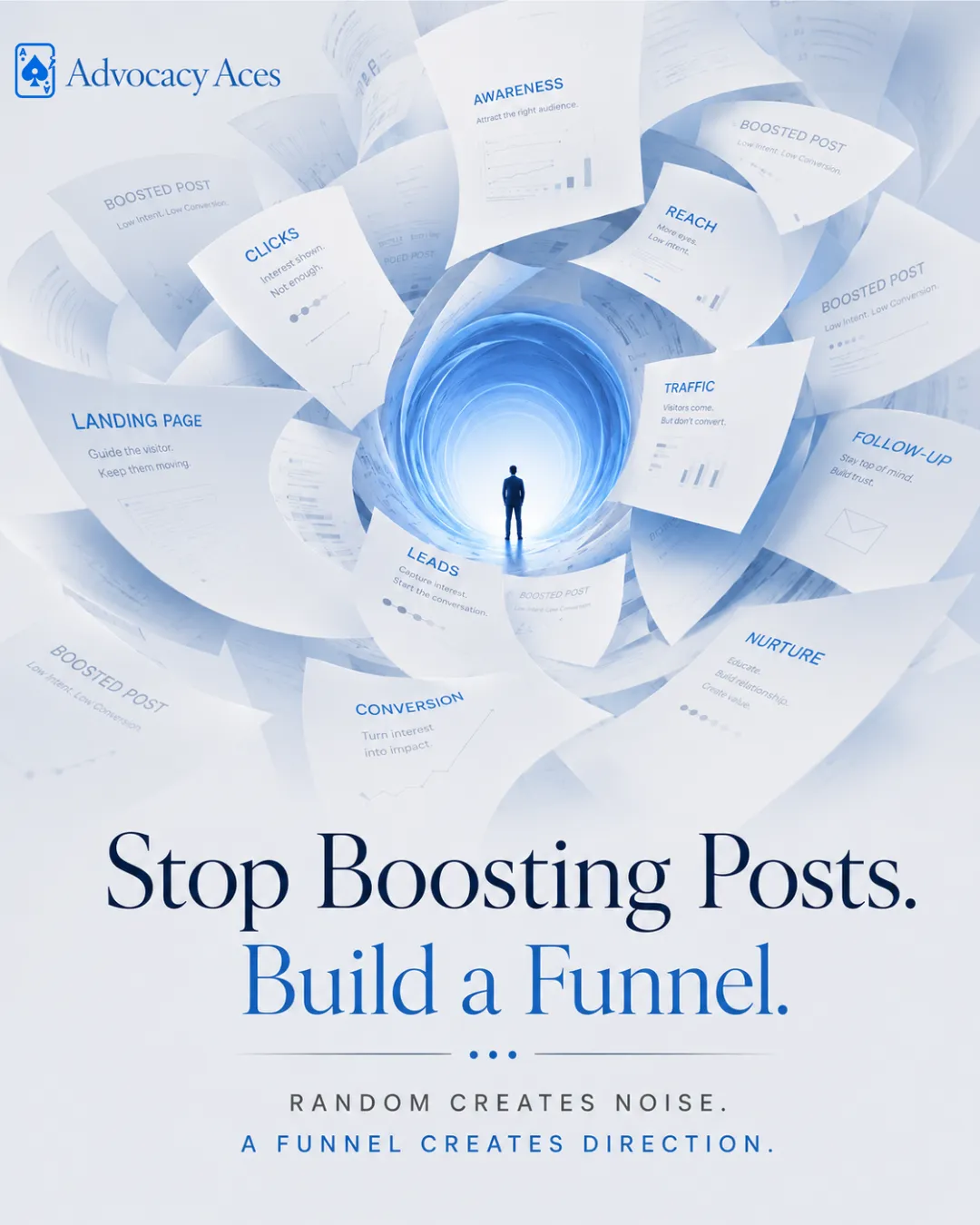
Noise fills a feed. A funnel is built to fill a calendar.
What are the stages of a marketing funnel?
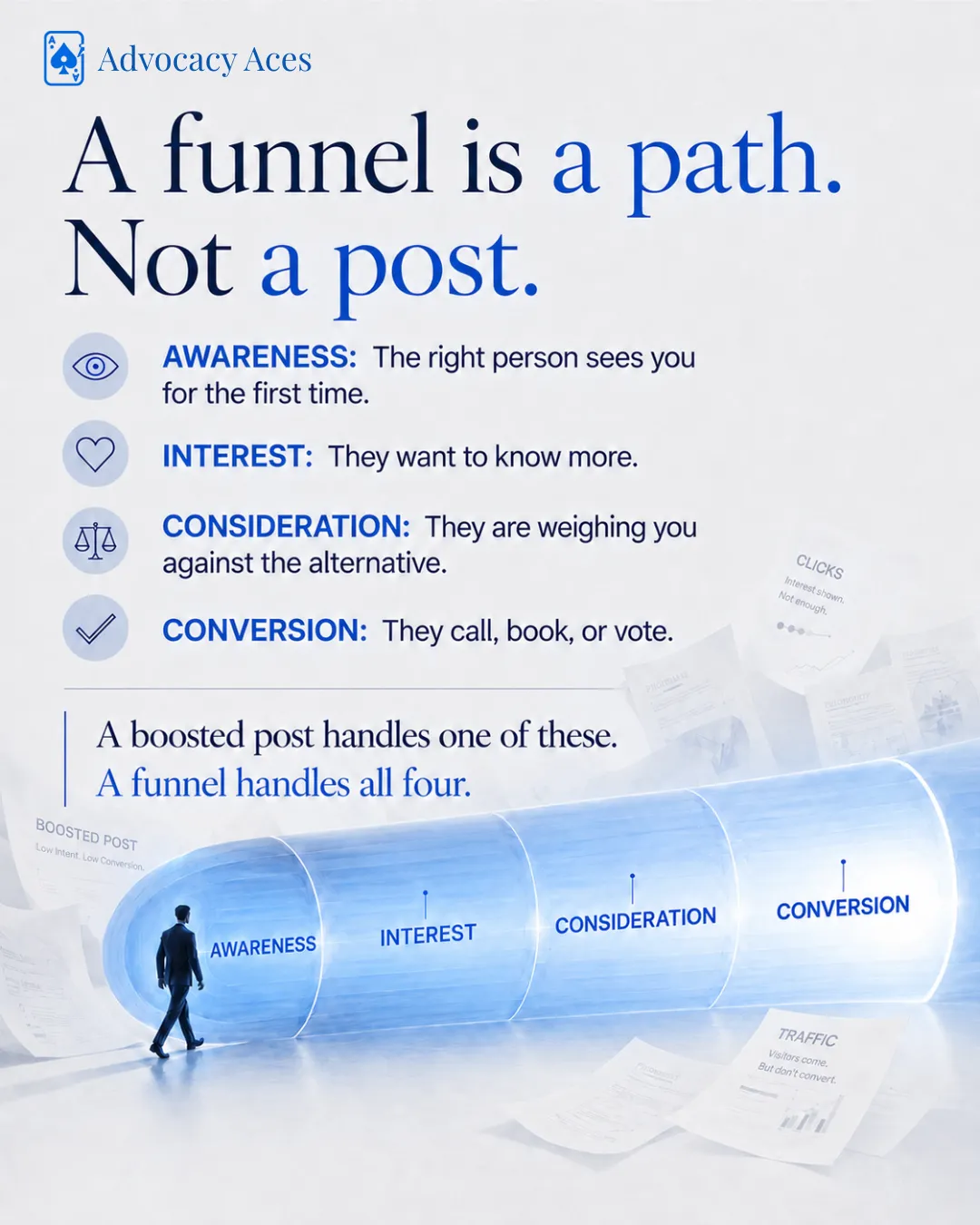
The funnel we build has four stages: awareness, interest, consideration and conversion. It is a path, not a post. Each stage has a job of its own.
| Stage | What is happening | Law firm example | Campaign example |
|---|---|---|---|
| Awareness | The right person sees you for the first time. | A short video in English and Spanish on what to bring to a first consultation, shown to adults in the counties the firm serves. | A short video introducing the candidate, shown to adults who live in the district. |
| Interest | They want to know more. | They watch most of the video or visit the practice area page. | They watch the video, follow the Page or read the issues page. |
| Consideration | They are weighing you against the alternative. | A retargeted ad explains how the consultation works and which languages the staff speaks. | A retargeted ad shows the candidate’s plan on the issue the viewer engaged with. |
| Conversion | They call, book or vote. | They request a consultation through a short form or tap to call. | They donate, sign up to volunteer or make a plan to vote. |
A boosted post usually handles one of these stages. A funnel handles all four. Each stage needs a different message, and one post cannot carry them all.
Where does a boost-only budget go?
A boost-only budget leaks in four places when no funnel stands behind it. Look for each one in your own reports.
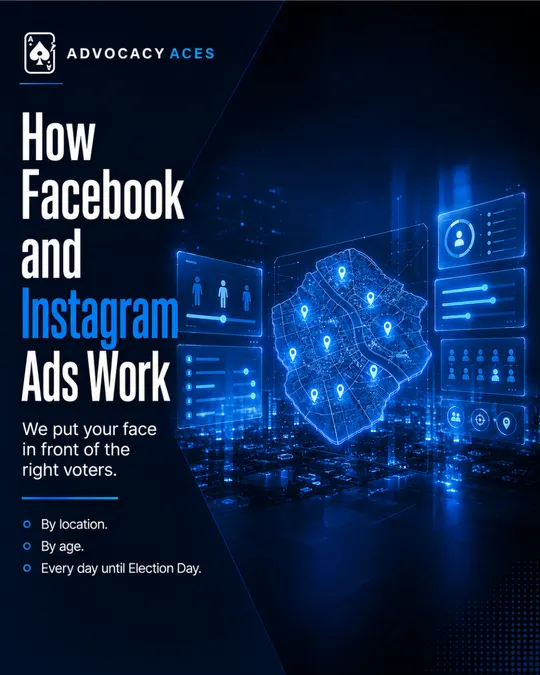
- Impressions from people who are not your voters or clients. Meta’s location targeting reaches people who live in a place, were there recently or go there often. When you pick a city or region in Ads Manager, an option to reach more people likely to respond may be checked by default, and Meta says complete accuracy is not guaranteed. So delivery can include people who were only there recently. Check your location settings before you spend.
- Clicks to a page with no offer and no next step. A homepage makes a visitor hunt for what to do.
- Traffic that lands and leaves because nothing is waiting for them. No short form, no phone number up top, no reason to act today.
- Dollars that reached someone and gave them nothing to do. A like does not book a consultation or recruit a volunteer.
A boosted post with nothing behind it is a conversation that started and immediately ended. The fix is not to stop advertising. It is to finish the conversation.
What does a funnel look like for a law firm?
A law firm marketing funnel has five working parts. Together they close the leaks from the list above.
Step 1: The ad
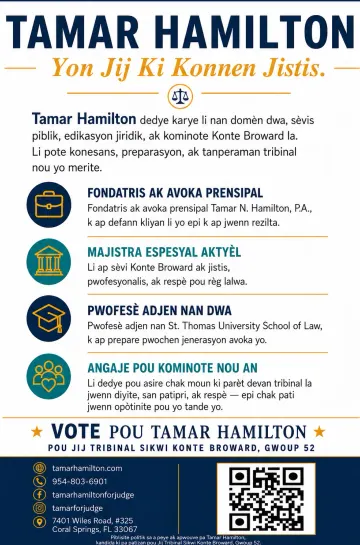
Start with one practice area and one audience, in the language your clients use at home. We produced law firm video ad creative in English and Haitian Creole for Claxton Law Group on immigration topics.
Step 2: The landing page
Send the click to a page built for that ad, not your homepage: one practice area, one action, a short form and a tap-to-call number. The Florida Bar’s rules treat websites the same as other advertising media. Rule 4-7.12 requires the name of at least one lawyer or the firm, the city, town or county of a bona fide office, and required statements in every language used. The firm’s website is exempt from filing, but not from the other advertising rules. Keep the call to action simple, like “Request a consultation,” and check the Bar’s rules before adding fee or results language. Our landing pages built with AI on Vercel are made for this job, and edits take hours, not weeks.
Step 3: Intake that answers
This is where many firms lose the lead. In Clio’s 2024 secret shopper study of 500 U.S. law firms, only 40 percent of firms answered the phone calls and 33 percent responded to the emails. An ad cannot fix an unanswered phone. Our AI intake and follow-up for law firms and campaigns, built with our partner DeskWolf, gives every request a first response at any hour and hands the details to a person on your team, who decides the next step.
Step 4: Follow-up
Someone who asked to hear from you should hear from you. Set up follow-up email and text sequences: a confirmation, a reminder before the consultation and a check-in if they did not book. Under Rule 4-7.18(b), communications made at a prospective client’s request are treated differently from unsolicited written outreach, so keep a record of who asked to be contacted.
Step 5: Retargeting
People who visited the page or watched your video already know you. Meta lets advertisers build Custom Audiences from people who visited a website or engaged on Facebook, plus lookalike audiences of new people similar to an existing audience. Show those warm audiences a consideration message. Our full-funnel Meta ads with retargeting are built around this step.
Which Florida Bar rules apply to a boosted law firm post?
The rules follow the money. The Florida Bar’s Advertising Guidelines for Networking Sites say posts a lawyer pays to place in the feeds of people with no prior family or professional relationship, which the Bar notes are sometimes called “sponsored” or “boosted,” must follow the advertising rules and be filed for review. The exception is a “tombstone” ad limited to the basic information in Rule 4-7.16. If a post is targeted only at people who have self-identified as having a specific legal need, the Bar says it must also meet Rule 4-7.18(b) and be filed.
The same guidelines treat a firm’s own networking page like its website, so the page itself is not filed. Paying to boost a post from it is what brings in filing.
The Bar says ads must be filed at least 20 days before their first use, with an accurate English translation for ads in other languages. Put that on the funnel calendar, including every Spanish or Haitian Creole version. Our law firm social media strategy guide covers the content rules for everyday posts.
This is marketing guidance, not legal advice. Confirm the details with The Florida Bar’s rules, or your own bar’s rules if you practice elsewhere.
Do immigration firm ads need Meta’s political authorization?
Sometimes. Immigration is on Meta’s list of social issues for the United States, and social issue ads can require authorization and a “Paid for by” disclaimer. Meta also says ads whose primary purpose is promoting a service, with a call to action such as “Contact us” or “Book now,” might not be treated as social issue ads. That exception does not apply to services about or mentioning politicians, political parties, elections or legislation.
An ad inviting people to book a consultation reads differently from an ad commenting on an immigration bill. Meta reviews each ad’s content, so we do not rule on any single ad here. Check the policy before launch, and plan for authorization if your ads discuss policy or legislation.
What does a funnel look like for a political campaign?
A Facebook ads campaign funnel is built the same way as a law firm’s, tuned to a calendar that ends on Election Day. Its job is to turn a view into a donation, a sign-up or a vote.
- The ad. Introduce the candidate and one reason to care, in the languages of the district. Meta’s broad targeting includes gender, age and location, and Meta’s own lookalike example is a candidate building an audience from a current donor list to find new donors.
- A page with one job. Donate, volunteer or find voting information. One page, one button.
- Email and text. Thank new donors, confirm volunteer shifts and send reminders with fundraising emails and get-out-the-vote texts.
- Retargeting. People who watched the introduction see the next message: the plan, a volunteer ask or a donation ask. If an ad says a person or group supports the candidate, Florida law generally requires their specific approval in writing.
- Turnout reminders. As voting opens, shift to reminders about mail ballots, early voting and Election Day. Our Florida campaign advertising timeline counts back from those windows.
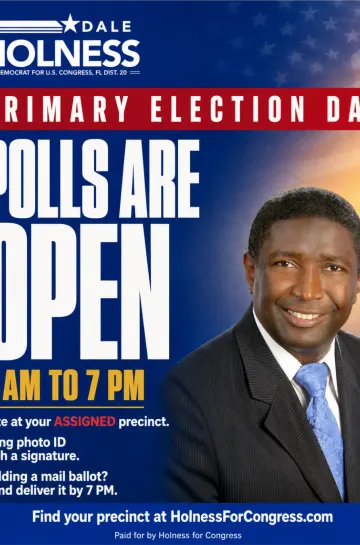
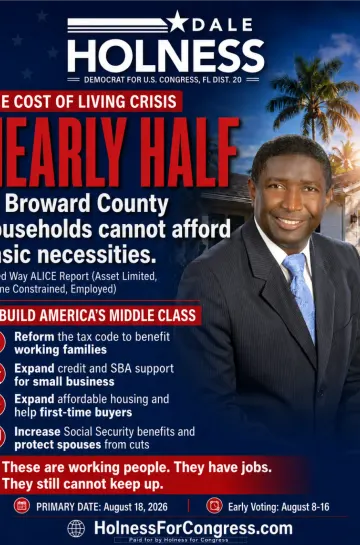
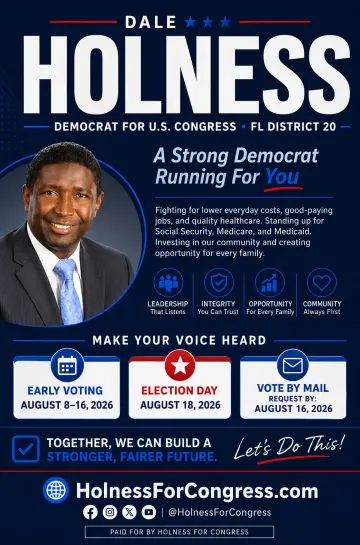
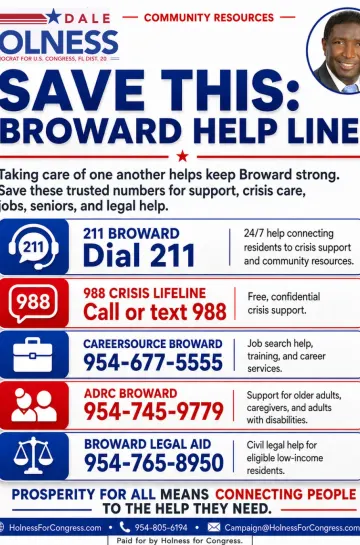
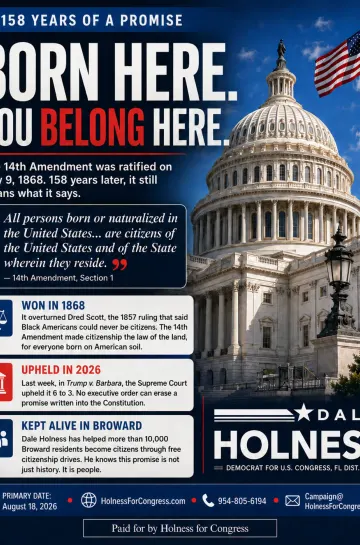
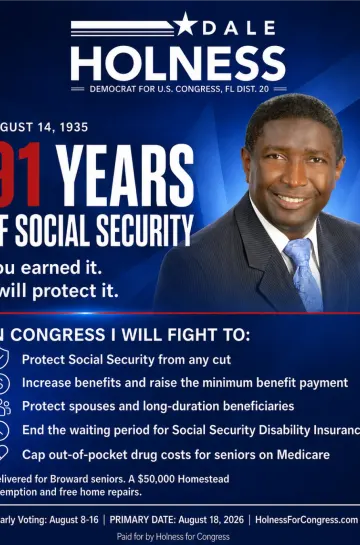
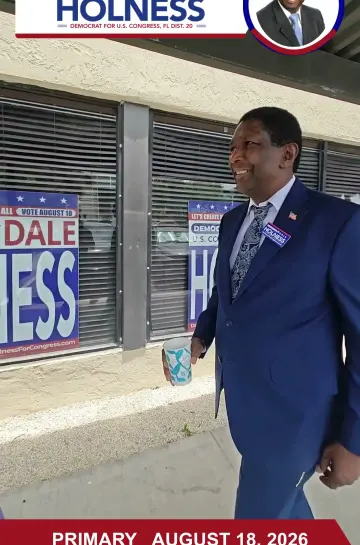
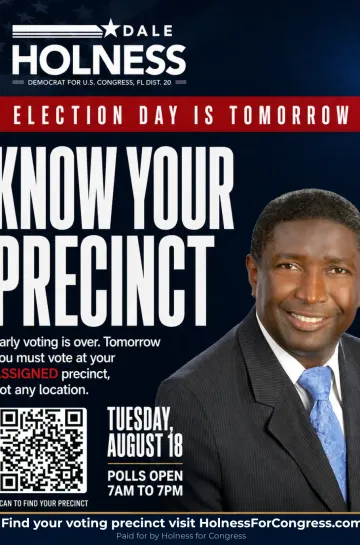
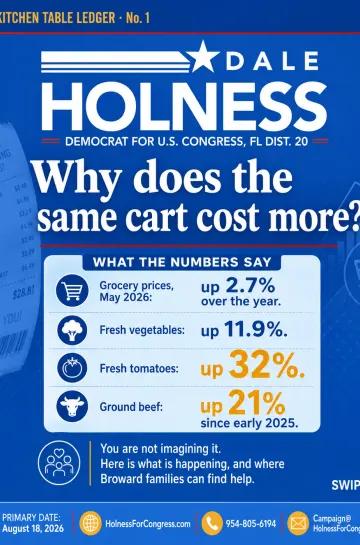
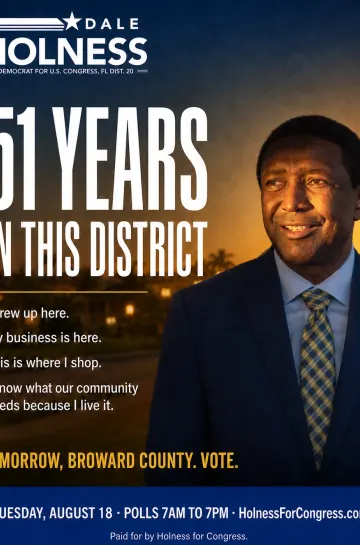
We ran Meta ads in English, Spanish and Haitian Creole for Dale Holness’s congressional primary, and the case study covers what the ads did and what we learned. For the bigger picture, read our Florida guide to digital marketing for political campaigns and our playbook for Facebook and Instagram ads for political campaigns.
Can you boost political posts on Facebook?
Yes, under the same rules as any political ad. The boost flow includes the Special Ad Category for social issues, elections or politics and an ad transparency step. On Meta, four things apply once you boost a political post, and election law adds its own disclaimer rules.
- Meta authorization. Advertisers running ads about social issues, elections or politics in designated countries must complete Meta’s authorization process, which Meta says is available to advertisers who reside and are located in the country they target.
- A verified “Paid for by” disclaimer. Political ads without a required disclaimer are disapproved during ad review. If one is already running, Meta says it will be paused, disapproved and added to the Ad Library until the advertiser completes authorization.
- A public record. Political and social issue ads are stored in Meta’s public Ad Library for seven years, so anyone can see what you boost.
- The final-week block. For the 2026 midterms, Meta says it will block new political, electoral and social issue ads during the final week of the U.S. election campaign, as it did in previous cycles. Ads that recorded at least one impression before then may keep running, so launch turnout ads early.
Florida state and local races. Florida defines a political advertisement as a paid expression that expressly advocates the election or defeat of a candidate, and the Internet is on the statute’s list of communications media. Under section 106.143, a candidate’s paid ad must carry a disclaimer such as “Political advertisement paid for and approved by” with the candidate’s name, party affiliation and office sought. Candidates in nonpartisan races may not state a party. The section exempts messages on an unpaid profile or account, or on a social networking site, when the source is patently clear. We do not rely on that exemption for paid boosts and plan for the full disclaimer on every boosted campaign post.
Federal races. The FEC counts communications placed or promoted for a fee on another person’s advertising platform as public communications, and any public communication made by a political committee, such as a campaign committee, must display a disclaimer. In text and graphic internet ads, the disclaimer must appear without the viewer taking any action, unless character or space limits allow an adapted disclaimer.
Confirm the details for your race with your campaign counsel or filing officer.
How do you move from boosting to a funnel?
You move in nine steps, from picking one conversion to reporting on it weekly. Work through them in order.
- Pick one conversion. A consultation request, a donation or a volunteer sign-up.
- Build the landing page for that single action, in every language you advertise in.
- Make the offer clear. Say what happens when someone acts: who follows up, when and what to bring.
- Set up tracking so the ad account sees the action you care about, not just clicks.
- Build your audiences. Location and age for reach, Custom Audiences from site visitors and video viewers for retargeting, lookalikes to find new people.
- Make creative for each stage. An introduction, an answer, a reason and a direct ask.
- Wire up intake and follow-up so every call, form and text gets answered.
- Clear compliance first. File non-exempt law firm ads with the Bar at least 20 days before first use. Get Meta authorization and disclaimers in place before a campaign ad runs.
- Report weekly. Judge ads by the conversion you picked, not by likes, and replace the ones that fall behind.
If your team runs its own ads, our enterprise ad consulting for in-house teams includes account and creative audits, media planning, reporting setup and training, and you keep the keys.
How can Advocacy Aces help you build a funnel?
Advocacy Aces is a digital advertising and creative agency for law firms and political campaigns, working in English, Spanish and Haitian Creole. We build the whole path: strategy, copy, targeting and execution.
- One team owns targeting, copy, creative, media buying and reporting, and we walk you through the results.
- We run Meta, Google Search, YouTube and X ads with retargeting and a weekly creative refresh.
- We build the landing pages, the email and text sequences and, with DeskWolf, the AI intake behind them.
- You keep ownership of your ad accounts, ad spend goes directly to the platforms, and we take one client per race.
Stop building noise. Start building a funnel. If you are boosting posts and want them to lead somewhere, Schedule Consultation.
This article is marketing guidance, not legal advice. Election, platform and bar rules change, so confirm the details with your campaign counsel, filing officer or bar before you rely on them.